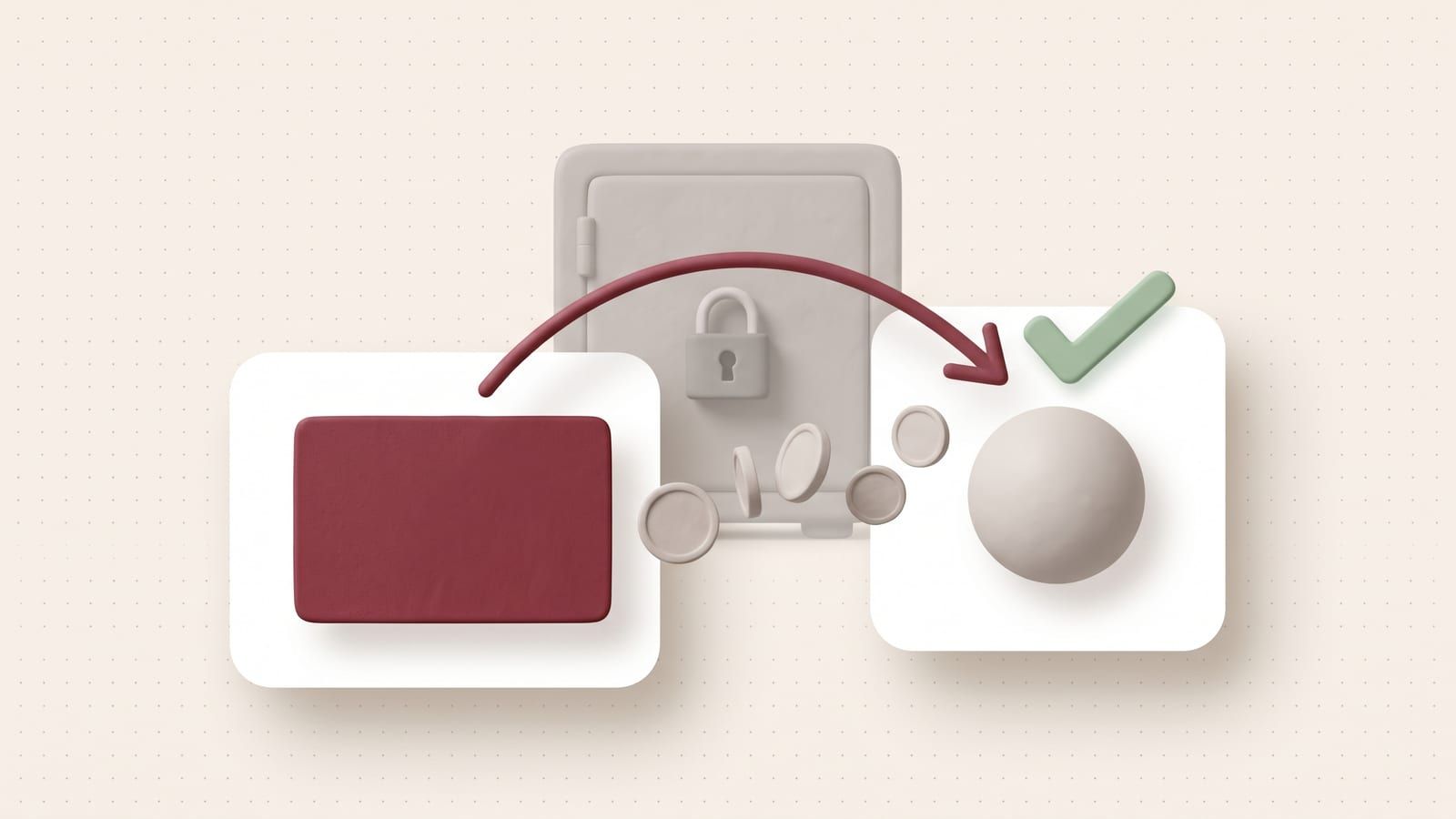
No. Creator payments do not need escrow; they need a clear contract and a payment that fires when each condition in it is met. Escrow means a third party keeps the money until a condition is satisfied, which in some US states, California the best-known, is a licensed activity. A pay-when-due model with the brand's card on file gives creators the same certainty without anyone sitting on the money.
On this page
- Key takeaways
- What does escrow actually mean?
- Why is holding other people's money a licensing problem for platforms?
- What do creators actually want from escrow?
- What works instead: the pay-when-due model
- How do the models compare?
- What should brands and creators ask a platform about payments?
- How TwoBit helps
- Frequently asked questions
Key takeaways
- Escrow is a legal term for a third party keeping money until a condition is met. In California, doing this over the internet for consumers is licensed under the Escrow Law.
- Taking in money to pass on to someone else can also count as money transmission, which most states license.
- What creators want from escrow is certainty: that the brand can pay, will pay, and when. A contract with payment events and a card on file delivers that.
- Pay-when-due means the brand's card is charged at each contract event and the money goes to the creator's account, with no pooled funds in between.
- Ask any platform plainly: do you hold my money, and under what authority?
What does escrow actually mean?
Escrow is an arrangement in which one party hands money to a neutral third party, who keeps it until a condition is met and then delivers it to the other party. In many places the word has a precise legal meaning.
California's definition, as published by the state's financial regulator, the DFPI, is a transaction in which one person "delivers any written instrument, money, evidence of title to real or personal property, or other thing of value to a third person to be held by that third person until the happening of a specified event or the performance of a prescribed condition, when it is then to be delivered by that third person" to the other party (DFPI, About the Escrow Law). Replace "written instrument" with "a brand's $1,000 fee" and "prescribed condition" with "the brand approves the Reel", and you have the creator-platform case.
This article is general information, not legal advice; a payments lawyer can tell you how these rules apply to your facts.
Why is holding other people's money a licensing problem for platforms?
Because several bodies of law treat taking in money to keep or pass on as a regulated financial service, whatever the business calls itself.
Escrow law. California's Escrow Law (Financial Code, Division 6, from section 17000) is administered by the DFPI, which licenses escrow agents, joint control agents and "Internet escrow agents". The DFPI states that "persons or companies performing escrow services over the Internet in California, or performing escrow services over the Internet for consumers in California, are subject to the licensing requirements of the Escrow Law." The law's exemptions are mainly banks, attorneys acting for clients, title companies and real estate brokers, and the burden of proving one falls on the person claiming it. A creator marketplace fits none on its face.
Money transmission law. Separately, California's Money Transmission Act (Financial Code, Division 1.2, from section 2000) requires a license to engage in money transmission in the state unless an exemption applies, and receiving money for transmission to someone else is one of the activities it covers (DFPI, Money transmitters). Most other states have their own money transmitter statutes, and federally, money transmitters generally register with FinCEN. A platform that collects a brand's fee into its own account and later sends it to a creator is, in plain terms, receiving money for transmission.
What licensing involves. Typically an application, background checks, minimum net worth, a bond, segregated accounts and periodic examinations, state by state. For a payments company that is the cost of doing business; for a marketplace whose job is matching brands and creators, it is a second company bolted on to the first.
The quieter problem: the float. Money sitting in a platform account between "brand paid" and "creator approved" earns interest, carries chargeback risk and becomes an asset in any insolvency. A model with no pooled funds has none of those questions.
What do creators actually want from escrow?
Creators want three assurances, none of which requires a third party to keep the money: that the brand is real and can pay, that payment will happen once they have done their part, and exactly when that is. Escrow is one way to deliver those, with the licensing baggage above.
Look at what actually goes wrong: a draft that waits weeks for feedback, an invoice stuck in a queue, "we'll pay after the post" becoming net 60, a brand that turns out to be fake. How to make sure you get paid on time covers each, and none is solved by a platform sitting on cash. They are solved by payment events in the contract, a timer on approvals, a verified brand and a payment method set up before work starts.
What works instead: the pay-when-due model
Pay-when-due means the brand's card stays on file, the contract names the events at which each part of the fee is due, and at each event the platform charges the card and the processor routes it to the creator's own account. Nobody keeps the money in between:
- Both sides sign a contract with a payment schedule: at signing, on approval, when the post is live, or half and half.
- The brand adds a card and authorizes charges on those events; the card is verified, so the creator knows a working payment method exists.
- At each event the card is charged and the processor settles the money to the creator's connected account, then pays it out to their bank on its schedule.
- The contract has a silence rule: a draft the brand leaves unanswered for an agreed period counts as approved and the next payment is due, unless the brand raises a specific problem.
- If a charge fails, the brand is told, the creator can see the status, and the brand pays from its payments page.
The brand's cash stays put until the work is done; the creator's payment is tied to finishing the work, not to someone remembering to release funds; and the regulated activity, moving money, is done by the regulated processor. The schedules themselves are compared in net 30, on approval or on signing?.
How do the models compare?
The three models differ in who has the money during the work and who is doing a licensed activity.
| Escrow-style holding | Pay-when-due with card on file | Pay after invoice | |
|---|---|---|---|
| Where the money sits during the work | Platform's account | Brand's account | Brand's account |
| Who moves the money | Platform (licensed, or should be) | Payment processor | Brand's bank |
| Creator's certainty | High, if the platform is solvent and licensed | High: verified card, contract events, timer | Low: depends on the brand's AP process |
| Brand's cash flow | Worst: pays up front | Pays at each event | Best for the brand, worst for the creator |
| Typical cost | Platform fee or commission to cover compliance | Card processing per charge | Staff time, late payments |
| Interest on balances | Platform's question to answer | None | None |
Fees often follow the model: keeping funds costs money to do properly, and that cost tends to show up as a commission on the creator's fee. How brands pay creators sets out methods and fees.
What should brands and creators ask a platform about payments?
Ask five questions and expect plain answers.
- Do you ever hold my money, and if so, where is it and under what license?
- What exactly triggers each payment, and can both sides see the status?
- What happens if the brand does not respond to a draft?
- What happens if a charge fails, and who is told?
- Who pays processing fees, and do you take a commission on the creator's fee?
Plain one-sentence answers usually mean a simple model.
How TwoBit helps
TwoBit does not hold money and is not an escrow service. The brand keeps a card on file and authorizes TwoBit to charge it when each part of the creator's fee is due under the contract: at signing, on approval of the content, when the post is live, or half at signing and half on approval. Each charge goes straight to the creator's Stripe account, with payouts to US bank accounts. The brand pays card processing of 2.9% + 30¢ on each payment; the creator keeps 100% of the fee and TwoBit takes no commission. The brand approves content in the app, and the next payment follows the signed schedule. If a charge fails, the brand is told and pays from the Payments page. Every payment sits under a contract both sides signed (what an influencer contract should include). More on the FAQ.
Frequently asked questions
Is escrow illegal for a creator platform?
Not illegal, but regulated. In California, performing escrow services over the internet for consumers in the state requires a license under the Escrow Law, and taking money to pass on to someone else can fall under money transmission laws in many states. A platform can do it with the right licenses, which is a large commitment for a small marketplace.
Without escrow, what stops a brand from never paying?
The contract and the card on file. When the brand has signed a payment schedule and authorized charges on stated events, the payment happens when the event happens, not when someone remembers. Verified card details, a silence rule for approvals and a visible record of failed charges close most of the gap, and the brand's verified identity does the rest.
Doesn't a card on file mean the brand can cancel the card?
A brand can always cancel a card, just as it could stop a bank transfer. What matters is what happens next: the creator is told the charge failed, the brand is asked to pay from its payments page, and the contract says whether the creator may pause work. Most failures are expired cards, not bad faith.
Is a pay-when-due platform the same as net 30?
No. Net 30 starts a clock after an invoice, usually after the post, and the creator waits. Pay-when-due charges the brand's card at the contract event itself, such as approval or the live post, so the money moves the day the condition is met rather than 30 days after a document is processed.